Learn · Unit plans · Grade 5 · Social Studies · Strand B
Grade 5: who looks after the Great Lakes?
A Social Studies unit on government and citizenship, built on the shared management of the Great Lakes.
lessons of about 50–60 minutes, including two for the action plan.
The expectation whose examples name government policies for managing the Great Lakes.
The treaty that still guides how Canada and the U.S. share the lakes.
Why this unit
Grade 5 Social Studies asks students to assess how governments respond to important issues, to understand the levels of government and their responsibilities, and to create an action plan for an issue they care about. The curriculum's own examples include "policies related to the management of the Great Lakes", Great Lakes water contamination, and why Great Lakes pollution involves several governments. The lakes are a perfect case study: one water body, two countries, eight states, two provinces, many First Nations and tribes, and hundreds of towns.
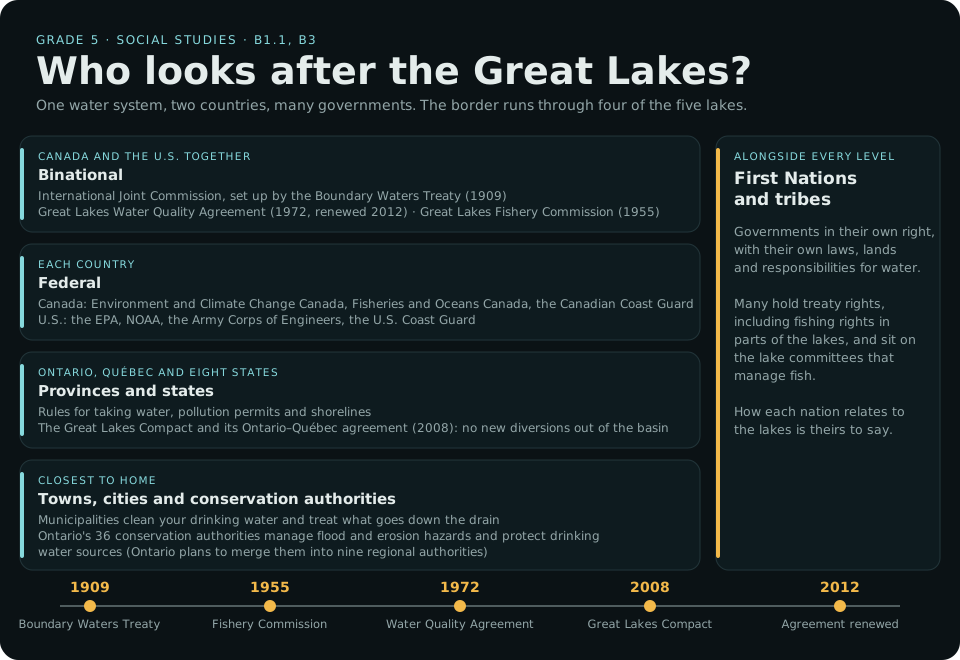
Text version and sources
- Binational: the International Joint Commission, set up by the Boundary Waters Treaty (1909); the Great Lakes Water Quality Agreement (1972, renewed 2012); the Great Lakes Fishery Commission (1955), which runs sea lamprey control.
- Federal: in Canada, Environment and Climate Change Canada, Fisheries and Oceans Canada and the Canadian Coast Guard; in the U.S., the EPA, NOAA, the Army Corps of Engineers and the U.S. Coast Guard.
- Provinces and states: Ontario, Québec and eight states set rules for taking water, pollution permits and shorelines. The Great Lakes Compact and its agreement with Ontario and Québec (2008) ban most new diversions out of the basin.
- Local: municipalities treat drinking water and wastewater; Ontario's 36 conservation authorities manage flood and erosion hazards and protect drinking water sources (Ontario plans to merge them into nine regional authorities).
- First Nations and tribes are governments in their own right. Many hold treaty rights, including fishing rights in parts of the lakes, and sit on the lake committees that manage fish. How each nation relates to the lakes is theirs to say.
- The Canada–U.S. border runs through four of the five lakes; Lake Michigan is entirely in the U.S.
Sources: International Joint Commission; Great Lakes Water Quality Agreement (binational.net); Great Lakes Fishery Commission; Government of Ontario: Ontario Provincial Conservation Agency and conservation authorities. More in Who looks after the lakes.
Expectations covered
| Code | In brief | Lessons |
|---|---|---|
| B1.1 | Assess how governments respond to significant issues (example: policies for managing the Great Lakes) | 3–5 |
| B1.3 | Create an action plan for an environmental issue | 8–9 |
| B2.1–B2.6 | The inquiry process, from several perspectives (sample questions include Great Lakes water contamination and why it involves several governments) | 2–7 |
| B3.1–B3.9 | Levels of government and their responsibilities, including water services (B3.2) and Indigenous harvesting and fishing rights (B3.7) | 1, 2, 6 |
Codes and summaries are paraphrased from Social Studies, Grade 5 (2026 edition). The Great Lakes appear in the Ministry's examples and sample questions. Strand A's expectations about the nations of the Great Lakes–St. Lawrence region (A3.1) and Métis origins (A3.6) belong with Indigenous educators and resources. Check the full wording on the Ontario Curriculum and Resources site.
The lessons
-
One lake, many governments B3
Read: Who looks after the lakes (Kids).
Live: On the map, follow the border through four of the five lakes. How many countries, states and provinces touch the lake nearest you?
Do: Make a "who's who" chart: federal, provincial or state, municipal, and First Nations and tribal governments, with one job each does for the lakes.
-
Who brings water to your tap? B3.2
Read: Lake to tap and source protection in Pollution and clean water.
Do: Trace a glass of tap water back to its source. Which level of government is responsible at each step?
-
Promises across the border B1.1
Read: The Boundary Waters Treaty, the Great Lakes Water Quality Agreement and the Great Lakes Compact in Who looks after the lakes (Students).
Do: Write each agreement as a promise in kids' words. Who made it, and who has to keep it?
-
Did it work? Cleaning up Lake Erie B1.1
Read: The Cuyahoga River fire and Areas of Concern in Pollution and clean water, and nutrients in Algae and water quality.
Live: Open Algae under More. Are there blooms in western Lake Erie today?
Do: Assess the government response: what improved after 1972, and what problems remain?
-
Who decides how high the water is? B1.1
Read: Water levels, and the boards that regulate Lake Superior and Lake Ontario in Who looks after the lakes.
Live: Open Water levels. Compare a gauge on Lake Ontario (regulated) with one on Lake Erie (not regulated).
Do: Role-play the Lake Ontario board: shoreline homeowners, shipping, a wetland, a town downstream. What should the board do in a very wet spring?
-
First Nations as governments B3.7
Read: The treaty fishery in Fishing the Great Lakes.
Do: Learn doesn't summarize Indigenous knowledge (see Indigenous relationships with the lakes). Use the map's Indigenous view to find whose territory and which treaty your school is on, then learn from that nation's own education resources, or invite a knowledge keeper or Indigenous educator, on their terms, through your board's Indigenous education lead.
-
Many perspectives B2
Do: Hold a lake council (from the Kids level of Who looks after the lakes): a city, a farm, a fishing family, a shipping company, a First Nation and a group of beach-loving kids each say what they need from the lake, then agree on three rules.
-
Culminating task: a class action plan B1.3, with B1.1 and B2
Over two lessons, the class chooses a local water issue (a polluted stream, a beach closing, litter on the shore, water use at school) and makes an action plan:
- what the problem is, with evidence from the map or local news;
- which governments are responsible, and what they're doing now;
- what the class proposes, and what the class itself will do;
- who to tell: a letter or presentation to the school council, the municipality or the conservation authority.
Assessment
- For learning: the who's-who chart and exit tickets.
- As learning: notes from the role plays, recording each perspective.
- Of learning: the action plan, across the four achievement chart categories: Knowledge and Understanding, Thinking (the inquiry), Communication (the letter or presentation) and Application.
Connections
- Science, Grade 5: Conservation of Energy and Resources (E1.1), resource use and climate change.
- Grade 6 unit: combined Grade 5/6 classes can share the action plan with Invaders of the Great Lakes.
Before you start
- Many buoys come out of the water from late October to May, so the number reporting changes with the season. Water-quality samples are hand-collected snapshots, not live readings.
- Turn on Teacher view under the level tabs on any Learn topic (or add
#allto its address) to see the Kids, Students and Adults levels together while you plan. - In The Lakes is a simulation for learning, not for navigation, and doesn't give safety or health advice. For any trip to the water, follow your board's field trip and water-safety policies.
Tell us how this unit works in your class, or what's missing: admin@inthelakes.ca.
For teachers
Using this in class? Tell us
A minute of your time helps keep In The Lakes free: it shows funders and partners that classes really use it, and tells us what to improve.
This form needs JavaScript. You can also write to admin@inthelakes.ca.
How these lessons are made
Each lesson and unit plan is researched and drafted with the help of AI tools, and edited by the site's creator. Every lesson lists its sources, so you can check it for yourself. Figures are rounded. Curriculum links are a planning aid, not an official alignment. Ontario teachers who review a unit are thanked on that unit. This is a living project: spotted a mistake, or know more? Tell us, or help improve it. admin@inthelakes.ca