Learn · Courses · Course 1 of 7
Course 1 · 5 lessons
The making of the lakes
Rock, ice and water: how the basins formed, what they're made of, where their water comes from, why it rises and falls, and how they compare with the world's other great lakes.
Read the video's text
The making of the lakes
Billions of years of rock, one ice age, and the rain that still fills them.
1 · Rock Rocks and minerals
Under the lakes lie more than three billion years of Earth's history, laid down one chapter at a time.
Ancient Shield rock, iron from the early oceans, lava from a rift that almost split the continent, and coral from tropical seas.
1.1 bn: years since North America began to tear apart under Lake Superior
2 · Ice How the lakes formed
About 20,000 years ago, a sheet of ice more than a kilometre thick covered all of it.
As it melted back, it left basins scooped out of the softer rock, and its meltwater filled them. The last ice left Lake Superior's basin about 10,000 years ago.
406 m: Lake Superior's deepest point, scooped out by the ice
3 · Water Rivers and watersheds
Rain and snow fall on a bowl of land more than twice the size of the lakes, and run downhill into them.
Then the water steps down from lake to lake to the sea. Superior is so big that a drop waits there about 191 years.
191 yrs: how long a drop stays in Lake Superior, on average
The big idea
The rock decided where the ice could dig. The ice dug the basins. The rain keeps them full.
Lessons in this video: Rocks and minerals · How the lakes formed · Rivers and watersheds
The Great Lakes are young, but the rock around them is old: over the last two million years or so, ice sheets advanced and melted back again and again, scouring out the basins in rock that is in places billions of years old. This course starts there, with how the lakes formed and what they're made of, then follows the water: the rivers and watersheds that fill them, why their levels rise and fall, and how they compare with the other great lakes of the world.
Start with How the lakes formed: every lesson after it builds on the shape of the basins and the rock around them.
Start with lesson 1: How the lakes formed →
The course on one page
Text version and sources
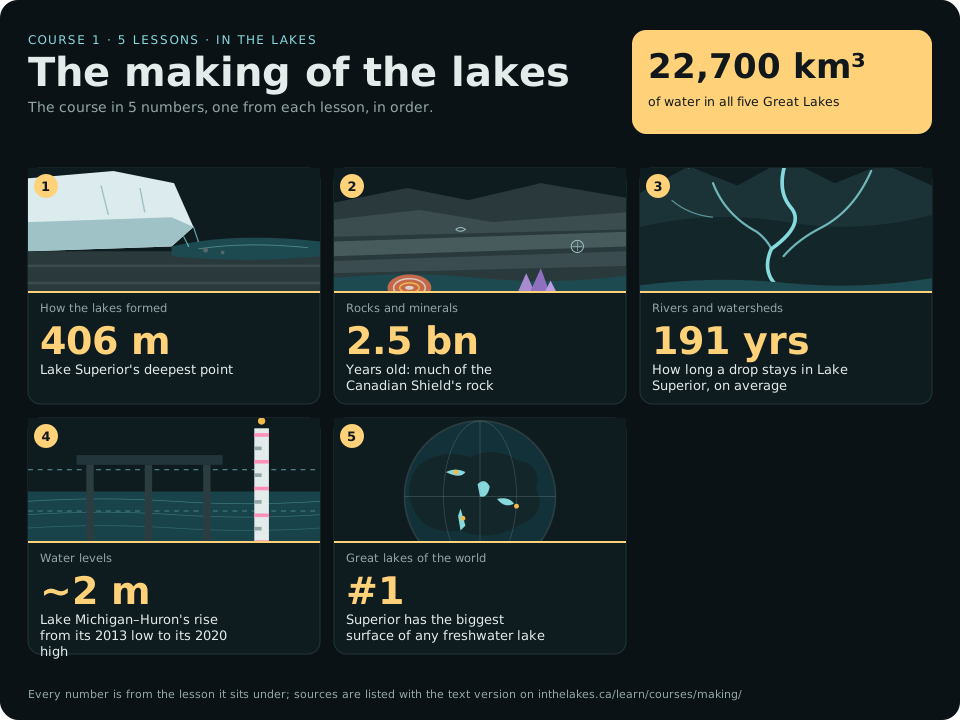
- The whole course: 22,700 km³ of water in all five Great Lakes. Source: U.S. EPA: physical features of the Great Lakes.
- 1. How the lakes formed: 406 m, lake Superior's deepest point. Source: U.S. EPA: Great Lakes facts and figures.
- 2. Rocks and minerals: 2.5 bn, years old: much of the Canadian Shield's rock. Source: Natural Resources Canada: geology and the Canadian Shield.
- 3. Rivers and watersheds: 191 yrs, how long a drop stays in Lake Superior, on average. Source: U.S. EPA: physical features of the Great Lakes.
- 4. Water levels: ~2 m, lake Michigan–Huron's rise from its 2013 low to its 2020 high. Source: NOAA GLERL: Great Lakes water level dashboard.
- 5. Great lakes of the world: #1, superior has the biggest surface of any freshwater lake. Source: ILEC World Lake Database: Lake Superior.
The lessons
Experience it in 3D
- Climb the Sleeping GiantOntario's highest cliffs, and a billion years of rock
- Float the KamOver Kakabeka Falls to Lake Superior
- Walk the Welland CanalAround the 99 m drop at Niagara, with a lockmaster
Unit plans that use this course
- Grade 3: living and working by the Great LakesGrade 3 · Social Studies · Strand B
- Grade 5: who looks after the Great Lakes?Grade 5 · Social Studies · Strand B
- Grade 7 Science: the lake as an ecosystemGrade 7 · Science and Technology · Strand B
- Grade 8 Water Systems, with live Great Lakes dataGrade 8 · Science and Technology · Strand E
- Grade 9 Geography: the Great Lakes as a Canadian systemGrade 9 · Geography · CGC1W
- Grade 10 Science: the Great Lakes and climateGrade 10 · Science · SNC2D strand D