Learn · Courses · Course 5 of 7
Course 5 · 7 lessons
The working lakes
The ships, locks and ports that move ore, grain, stone and steel, the water that reaches our taps, the ferries islands depend on, and the power and jobs the lakes provide.
Read the video's text
The working lakes
The ships, the locks, and the water in your glass.
1 · A highway for heavy things Commercial shipping
Iron ore, grain, stone, salt and cement travel by ship, because one ship can carry what would take hundreds of rail cars.
The biggest lakers are about 1,000 feet long. One of them holds about as much iron ore as 800 rail cars.
2 · The staircase Locks and canals
From the Atlantic to the head of Lake Superior, ships climb about 180 metres over roughly 3,700 km.
The Seaway's locks lift them about 68 m to Lake Ontario. The Welland Canal's 8 locks lift them about 100 m around Niagara Falls. The Soo locks, about 7 m more.
180 m: the climb from the Atlantic to Lake Superior
3 · From lake to tap From lake to tap
The same lakes fill our glasses. About 1 in 4 Canadians drink water that comes straight from the Great Lakes.
Water enters an intake crib as much as 2 km offshore, runs along the lake bottom to a treatment plant, and is cleaned before it reaches the tap.
1 in 4: Canadians drink water straight from the Great Lakes
The big idea
The lakes are a working highway and a water supply: they carry the iron for our steel and the water for our taps.
Lessons in this video: Commercial shipping · Locks and canals · From lake to tap
The lakes are a highway and a workplace. This course follows the ships that carry ore, grain, stone and steel, the locks and canals that lift them past rapids and falls, and the ports where they load. Then it turns to the power the lakes help make, the water that reaches your tap, the ferries that islands depend on, and the people who work on the water.
The 3D tours put you aboard: walk a 1,000-foot laker, ride a lock, tour a port, or captain a ferry.
Start with lesson 1: Commercial shipping →
The course on one page
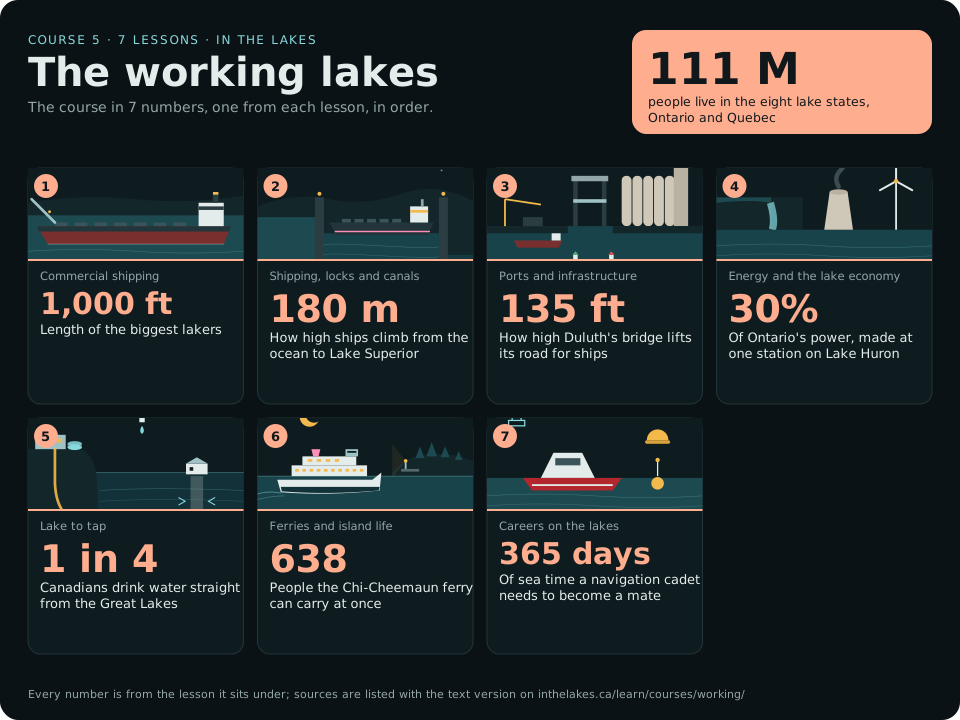
Text version and sources
- The whole course: 111 M people live in the eight lake states, Ontario and Quebec. Source: Great Lakes and St. Lawrence Governors and Premiers: economic outlook (2025).
- 1. Commercial shipping: 1,000 ft, length of the biggest lakers. Source: Lake Carriers' Association.
- 2. Shipping, locks and canals: 180 m, how high ships climb from the ocean to Lake Superior. Source: The St. Lawrence Seaway.
- 3. Ports and infrastructure: 135 ft, how high Duluth's bridge lifts its road for ships. Source: Duluth Seaway Port Authority.
- 4. Energy and the lake economy: 30%, of Ontario's power, made at one station on Lake Huron. Source: Bruce Power: about us.
- 5. Lake to tap: 1 in 4, canadians drink water straight from the Great Lakes. Source: Environment and Climate Change Canada (2019).
- 6. Ferries and island life: 638, people the Chi-Cheemaun ferry can carry at once. Source: Ontario Ferries: MS Chi-Cheemaun.
- 7. Careers on the lakes: 365 days, of sea time a navigation cadet needs to become a mate. Source: Transport Canada: how to become a seafarer.
The lessons
Experience it in 3D
- Tour a portSix harbours in 3D, with the ships there now
- Cruise the Soo LocksA guided boat tour, up and down at Sault Ste. Marie
- Walk the Welland CanalWith a retired lockmaster, to the Fallen Workers Memorial
- Walk the Stewart J. CortAboard the first 1,000-footer
- Under the Mackinac BridgeA guided boat tour of the Mighty Mac
- Visit the Moses-Saunders DamAlong the top of the dam and down to a turbine
- Captain the Chi-CheemaunLoad a ferry and cross to Manitoulin
Unit plans that use this course
- Grade 3: living and working by the Great LakesGrade 3 · Social Studies · Strand B
- Grade 5: who looks after the Great Lakes?Grade 5 · Social Studies · Strand B
- Grade 6: invaders of the Great LakesGrade 6 · Science and Technology · Social Studies
- Grade 8 Water Systems, with live Great Lakes dataGrade 8 · Science and Technology · Strand E
- Grade 9 Geography: the Great Lakes as a Canadian systemGrade 9 · Geography · CGC1W
- Grade 10 Science: the Great Lakes and climateGrade 10 · Science · SNC2D strand D