Learn · Courses · Course 6 of 7
Course 6 · 7 lessons
People and the lakes
Indigenous homelands, the newcomers who settled and industrialized the shores, who looks after the lakes now, the ships the lakes kept, and the lights and lifesavers who tried to save them.
Read the video's text
People and the lakes
Homelands, newcomers and industry, a shared border, and the ships the lakes kept.
1 · Shores transformed Settlement history · The industrial lakes
The Great Lakes were, and are, Indigenous homelands. From the 1600s newcomers arrived, and their forts and trading posts grew into cities.
After 1850 the shores became one of the busiest industrial regions on Earth: forests became lumber, iron ore became steel, and steel became cars.
2 · One water, two countries Governing the lakes
The border between Canada and the United States runs through four of the five lakes. The water doesn't stop at the line.
In 1909 the two countries signed a treaty to share boundary waters. In 1972, with Lake Erie choked by algae, they agreed to cut phosphorus, and Erie improved quickly.
1909: Boundary Waters Treaty · 1972: Great Lakes Water Quality Agreement
3 · The ships the lakes kept Shipwrecks · Lighthouses and lifesaving
Thousands of ships have been lost on the lakes. Each dot is a wreck on our map, appearing in the year it went down.
Lighthouses, lifesavers, storm warnings and radio cut the losses. Even so, one storm in November 1913 sank about a dozen ships in a few days.
The big idea
People built on the lakes, wore them down, and learned, slowly, to share them and look after them.
Lessons in this video: Settlement history · The industrial lakes · Governing the lakes · Shipwrecks · Lighthouses and lifesaving
People have lived around the lakes for thousands of years. This course begins with Indigenous relationships with the lakes, pointing to the nations themselves for their own knowledge, then follows the newcomers who settled and industrialized the shores, who looks after the lakes now, the ships the lakes kept, the lighthouses and lifesavers, and the eyewitnesses who wrote it all down.
Learn doesn't retell Indigenous knowledge: the map's Indigenous view shows whose lands and waters these are, and the nations are the ones to learn from.
Start with lesson 1: Indigenous relationships with the lakes →
The course on one page
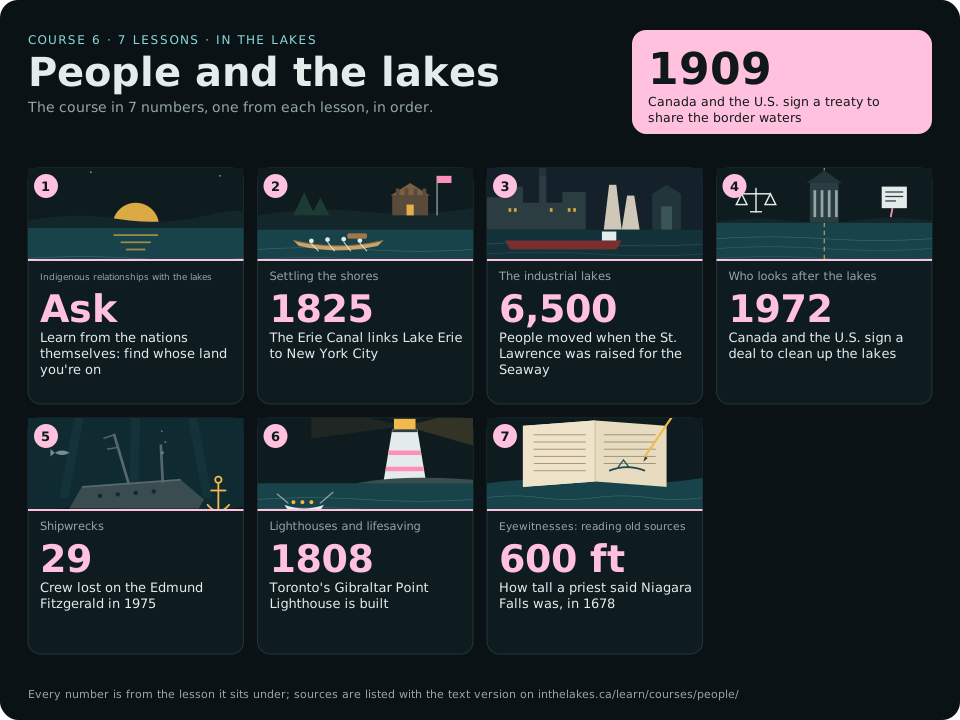
Text version and sources
- The whole course: 1909 Canada and the U.S. sign a treaty to share the border waters. Source: International Joint Commission.
- 1. Indigenous relationships with the lakes: Ask, learn from the nations themselves: find whose land you're on. More in the lesson.
- 2. Settling the shores: 1825, the Erie Canal links Lake Erie to New York City. Source: New York State Canal Corporation: the Erie Canal.
- 3. The industrial lakes: 6,500, people moved when the St. Lawrence was raised for the Seaway. Source: The Canadian Encyclopedia: the Lost Villages.
- 4. Who looks after the lakes: 1972, canada and the U.S. sign a deal to clean up the lakes. Source: International Joint Commission: history of the Water Quality Agreement.
- 5. Shipwrecks: 29, crew lost on the Edmund Fitzgerald in 1975. Source: U.S. NTSB: report on the Edmund Fitzgerald (1978).
- 6. Lighthouses and lifesaving: 1808, toronto's Gibraltar Point Lighthouse is built. Source: Toronto Public Library: Gibraltar Point Lighthouse history.
- 7. Eyewitnesses: reading old sources: 600 ft, how tall a priest said Niagara Falls was, in 1678. Source: Project Gutenberg: the eyewitness texts.
The lessons
Experience it in 3D
- Indigenous lands and watersTerritories, treaties and First Nations on the map
- Brigade to the Rendezvous, 1815A north canoe to Fort William
- Walk Fort WilliamInside the fort at the Rendezvous, with a guide
- Visit Fort WilliamIts map, place by place, with the sources
- Float the FrenchThe voyageur highway to Georgian Bay
- Float the CuyahogaThe river that caught fire, and came back
Unit plans that use this course
- Grade 3: living and working by the Great LakesGrade 3 · Social Studies · Strand B
- Grade 5: who looks after the Great Lakes?Grade 5 · Social Studies · Strand B
- Grade 6: invaders of the Great LakesGrade 6 · Science and Technology · Social Studies
- Grade 7 Science: the lake as an ecosystemGrade 7 · Science and Technology · Strand B
- Grade 8 Water Systems, with live Great Lakes dataGrade 8 · Science and Technology · Strand E
- Grade 9 Geography: the Great Lakes as a Canadian systemGrade 9 · Geography · CGC1W
- Grade 10 Science: the Great Lakes and climateGrade 10 · Science · SNC2D strand D