Learn · Courses · Course 3 of 7
Course 3 · 5 lessons
Life in the lakes
The food web from algae to lake trout, the people who fish it, the wetlands and shores that shelter it, and what keeps the water clean.
Read the video's text
Life in the lakes
Who eats whom, what too much phosphorus does, and the shores that shelter it all.
1 · The food web Fish and food webs
Everything in the lakes is linked by who eats whom: algae, tiny zooplankton, small fish, and big predators like lake trout.
Invaders rewired the web. Sea lamprey, with overfishing, wiped out most lake trout in Lakes Huron, Michigan and Superior by the 1950s.
180+: non-native species recorded in the Great Lakes
2 · Too much of a good thing Algae and water quality
Algae feed the whole lake. But phosphorus, washed off farms and out of cities, feeds them too much, and they bloom.
Lake Erie was cleaned up in the 1970s, then the blooms came back. In August 2014 a bloom's toxins reached Toledo's water intake, and hundreds of thousands of people couldn't drink their tap water.
40%: the cut in phosphorus that Canada and the U.S. set for western and central Lake Erie
3 · The edge of the lake Coasts, wetlands and wildlife
Coastal wetlands are the lakes' nurseries. More than 80 kinds of fish use them at some time in their lives.
About half of them are gone. But some things come back: piping plovers fell to about a dozen pairs in 1990, and 99 pairs nested in 2026.
80+: kinds of fish use Great Lakes coastal wetlands
The big idea
Everything in the lakes is linked. Pull one thread and the whole web moves, and people can help pull it back.
Lessons in this video: Fish and food webs · Algae and water quality · Coasts, wetlands and wildlife
Life in the lakes runs from algae too small to see to lake trout and sturgeon. This course follows the food web, the people who have fished the lakes for thousands of years, the algae that turn the water green, the coasts and wetlands where much of that life begins, and what keeps the water clean, or doesn't.
The marsh walks are the hands-on part: walk a wetland with an ecologist, test the water, and find the tiny life in it under a microscope.
Start with lesson 1: Fish and food webs →
The course on one page
Text version and sources
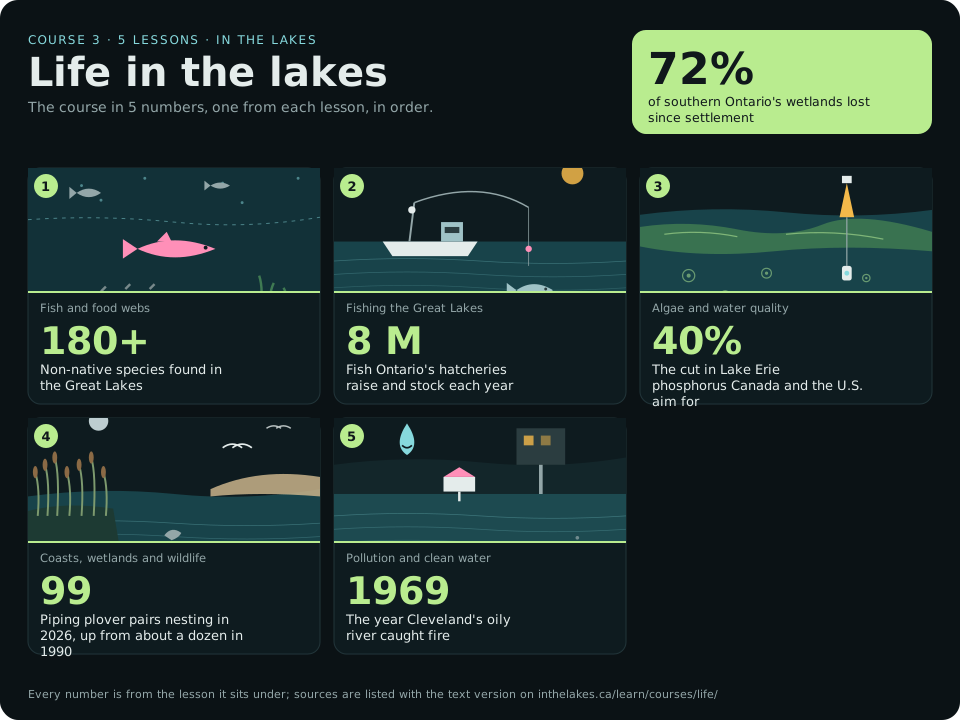
- The whole course: 72% of southern Ontario's wetlands lost since settlement. Source: Environmental Commissioner of Ontario: southern Ontario wetlands (2018).
- 1. Fish and food webs: 180+, non-native species found in the Great Lakes. Source: NOAA GLERL: GLANSIS, the Great Lakes non-native species database.
- 2. Fishing the Great Lakes: 8 M, fish Ontario's hatcheries raise and stock each year. Source: Government of Ontario: fish stocking program.
- 3. Algae and water quality: 40%, the cut in Lake Erie phosphorus Canada and the U.S. aim for. Source: Great Lakes Water Quality Agreement (binational.net).
- 4. Coasts, wetlands and wildlife: 99, piping plover pairs nesting in 2026, up from about a dozen in 1990. Source: U.S. Fish and Wildlife Service: piping plovers (September 2026).
- 5. Pollution and clean water: 1969, the year Cleveland's oily river caught fire. Source: Encyclopedia of Cleveland History: Cuyahoga River fire.
The lessons
Experience it in 3D
- Walk the Long Point marshCattails, turtles, and water sampling
- Walk Cootes ParadiseA city marsh coming back to life
- Fishing for SupperWhat a family caught in 1931, 1955 and 2015
- Coastal wetlands on the mapEvery coastal wetland on the Ontario side
Unit plans that use this course
- Grade 3: living and working by the Great LakesGrade 3 · Social Studies · Strand B
- Grade 5: who looks after the Great Lakes?Grade 5 · Social Studies · Strand B
- Grade 6: invaders of the Great LakesGrade 6 · Science and Technology · Social Studies
- Grade 7 Science: the lake as an ecosystemGrade 7 · Science and Technology · Strand B
- Grade 8 Water Systems, with live Great Lakes dataGrade 8 · Science and Technology · Strand E
- Grade 9 Geography: the Great Lakes as a Canadian systemGrade 9 · Geography · CGC1W
- Grade 10 Science: the Great Lakes and climateGrade 10 · Science · SNC2D strand D
- Grade 11 Environmental Science: testing the waterGrade 11 · Environmental Science · SVN3M / SVN3E